
Dometic Marine Air Conditioning: The Future of Yacht Climate Control

How variable-capacity technology is changing marine air conditioning — and why experienced technical service matters more than ever.
Marine air conditioning has come a long way. What was once a relatively straightforward combination of compressors, evaporators, thermostats, and seawater pumps has evolved into increasingly sophisticated climate-control technology.
Today's marine air conditioning systems can incorporate variable-speed compressors, electronic expansion valves, advanced digital controls, and communication networks that continuously monitor and adjust system operation.
For yacht owners, captains, and vessel managers, these developments offer exciting possibilities for onboard comfort, equipment efficiency, and space utilization.
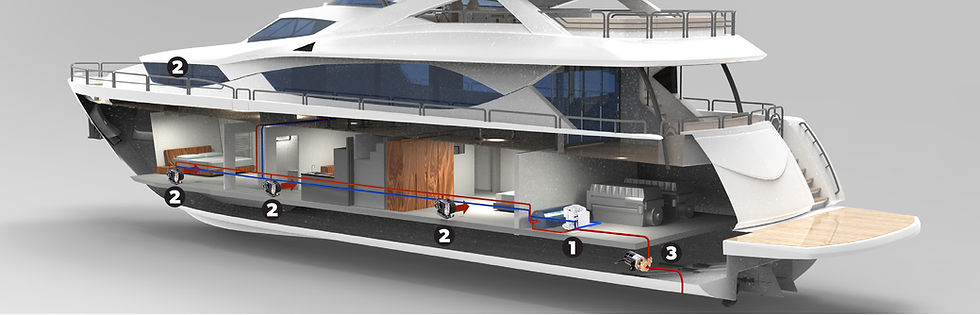
One example of this evolution is the Dometic Emerald Variable Capacity (EVARCX) marine air conditioning system, which introduces a different approach to traditional direct-expansion (DX) marine climate control.
At Tide & Iron Yacht Systems, our experience servicing Dometic marine air conditioning equipment spans more than 15 years, including manufacturer training and extensive hands-on work with conventional DX systems and complex chilled-water installations.
Let's take a closer look at what this technology means for the marine industry.
Understanding Traditional Marine Air Conditioning Systems
For decades, direct-expansion marine air conditioning systems have been a popular choice aboard recreational boats, sportfishing yachts, and motor yachts.
In a conventional split DX installation, a condensing unit is typically located in the engine room or another machinery space, while an evaporator and blower assembly are installed closer to the cabin being cooled.
Refrigerant circulates between the components, absorbing heat from the cabin and rejecting it through a seawater-cooled condenser.
Traditional fixed-speed compressors generally operate at their designed capacity when running. Once the thermostat reaches its set temperature, the compressor cycles off until cooling is required again.
These systems have served the marine industry for many years and remain a practical solution for numerous vessels.
However, depending on the installation, multiple cabins can require multiple condensing units, additional refrigerant piping, and increased machinery-space utilization.
Enter Variable-Capacity Marine Air Conditioning
One of the most significant developments in marine HVAC technology is the introduction of variable-capacity compressor operation.
Instead of operating exclusively at a fixed speed, an inverter-driven compressor can adjust its operating speed to better match the cooling demand.
Consider a yacht with several cabins.
During the afternoon, high ambient temperatures and solar heat gain may create significant cooling demand. Later in the evening, as temperatures decrease and cabins reach their desired setpoints, the required cooling capacity may be considerably lower.
A variable-capacity system can respond to these changing conditions by adjusting compressor output rather than relying exclusively on traditional full-capacity cycling.
Potential advantages include:
More consistent cabin temperature control
Reduced compressor cycling under suitable operating conditions
Lower starting-current surges
Improved efficiency during part-load operation
Reduced noise and vibration when operating at lower speeds
Actual performance depends on system design, installation, operating conditions, and maintenance.
Dometic's Emerald Variable Capacity System
Dometic's Emerald Variable Capacity (EVARCX) system demonstrates how modern control technology can be incorporated into a marine direct-expansion installation.
According to Dometic's published technical literature, the EVARCX48 condensing unit offers variable cooling capacity ranging from 6,000 to 48,000 BTU/h.
One of its most interesting features is the ability to connect up to five compatible evaporators to a single condensing unit.
Each evaporator has its own digital cabin control, allowing occupants to select individual temperature settings.
The condensing unit uses information from the connected evaporators to adjust compressor operation according to system demand.
This arrangement can reduce the number of condensing units required aboard a vessel, potentially freeing valuable machinery-space capacity.
Electronic Expansion Valves and Advanced Controls
Another important feature of the EVARCX system is its use of electronic expansion valves.
Traditional marine refrigeration systems commonly use thermostatic expansion valves or capillary-tube metering devices.
Electronic expansion valves allow refrigerant flow to be regulated through electronic controls, providing more precise management of operating conditions.
Dometic's EVARCX design also incorporates a programmable control system that communicates with the evaporators, monitors system operation, and manages condenser performance.
These components represent an important evolution in marine HVAC technology.
They also introduce additional electrical and electronic systems that technicians must understand when diagnosing equipment problems.
One Condenser, Multiple Cabins: What Yacht Owners Should Consider
The ability to serve multiple cabins from a single condensing unit is particularly interesting for vessels where engine-room space is limited.
Reducing the number of condensing units may simplify certain aspects of machinery-space layout and provide additional room for other onboard equipment.
However, system design must be carefully evaluated.
A shared condenser also means multiple cabins depend on the operation of the same refrigeration system.
A failure affecting the central condensing unit could interrupt cooling throughout the connected zones.
Additionally, while individual cabins can have different temperature settings, the EVARCX system operates its refrigerant circuit in a common cooling or reverse-cycle heating mode. Its compatible evaporators also incorporate electric heating capabilities.
These are important distinctions when evaluating whether a multi-zone variable-capacity system is appropriate for a particular vessel.
Why Modern Marine A/C Systems Require Specialized Technical Knowledge
As marine HVAC technology advances, troubleshooting increasingly involves more than connecting refrigerant gauges and checking compressor operation.
Modern equipment may incorporate:
Inverter-driven compressors and variable-frequency electronics
Electronic expansion valves
Programmable logic controllers
Digital temperature and pressure sensors
Communication networks between system components
Advanced electrical protection and diagnostic functions
A cooling problem that initially appears to be a refrigerant issue could involve a sensor, electrical connection, control signal, or communication fault.
Likewise, a compressor that does not operate may not necessarily have failed mechanically.
Accurate troubleshooting requires an understanding of refrigeration fundamentals along with electrical and electronic control systems.
Replacing components without identifying the actual cause of a malfunction can lead to unnecessary expenses and repeated service problems.
Over 15 Years of Experience with Dometic Marine Air Conditioning Equipment
At Tide & Iron Yacht Systems, we believe that technical experience and proper diagnostic procedures are essential to dependable marine air conditioning service.
Our background includes more than 15 years of hands-on experience working with Dometic marine HVAC equipment, including direct-expansion air conditioning systems and marine chilled-water plants.
Our technical qualifications also include Dometic factory training in Marine Chilled Water Troubleshooting, completed in January 2023.
That experience, combined with extensive work on sportfishing yachts, motor yachts, and other marine installations, provides a strong foundation for diagnosing and servicing complex onboard climate-control systems.
As an independent marine HVAC service company, Tide & Iron provides troubleshooting, repairs, maintenance, and retrofit evaluations for marine air conditioning equipment from multiple manufacturers.
Is It Time to Upgrade Your Yacht's Marine Air Conditioning?
New technology does not automatically mean every existing system should be replaced.
A properly installed and maintained conventional DX or chilled-water system may continue providing reliable performance for many years.
However, owners considering a major refit, replacing aging equipment, or addressing recurring cooling problems may benefit from evaluating newer marine HVAC technologies.
Before recommending a replacement, several factors should be considered:
Total cooling requirements and individual cabin heat loads
Existing electrical capacity and available power
Machinery-space dimensions and equipment access
Seawater circulation and condenser cooling requirements
Refrigerant piping layout and installation limitations
System serviceability and long-term maintenance needs
A successful retrofit involves more than selecting equipment based on BTU capacity alone.
It requires evaluating the vessel as a complete installation.
Dometic Marine Air Conditioning Service in the Chesapeake Bay, Savannah & Hilton Head
Whether your vessel operates with a conventional Dometic DX system, a marine chilled-water plant, or you are considering an upgrade to newer climate-control technology, professional evaluation is an important part of maintaining reliable onboard comfort.
Tide & Iron Yacht Systems provides marine air conditioning diagnostics, maintenance, repairs, and retrofit evaluations throughout:
The Chesapeake Bay region
Savannah and coastal Georgia
Hilton Head and the South Carolina Lowcountry
We are also available to travel throughout the East Coast for specialized marine HVAC service and installation projects.
Need Professional Marine Air Conditioning Service?
With more than 15 years of Dometic equipment experience, documented manufacturer training, and extensive knowledge of marine refrigeration and climate-control systems, Tide & Iron Yacht Systems is ready to assist with your vessel's air conditioning needs.
Call: 1-833-400-TIDE (8433)
Visit: www.tideandironmarine.com
Independent marine HVAC service provider. Previous manufacturer training and service experience do not imply current Dometic dealer authorization.
Technical reference: Dometic Emerald Variable Capacity Split System (EVARCX48) manufacturer literature. Equipment features and specifications are based on the supplied brochure; current product availability and compatibility should be confirmed with the manufacturer.


Comments